From the travel desk of Arun Sastry: September newsletter

September 2026: From the travel desk of Arun Sastry
Read about our news and latest updates.
Rails, Reefs, & Rum: Unlocking Historic Hideaways and Underwater Wonders around a set of islands in the middle of the Atlantic Ocean!

Hands-free, barefoot walking on the seabed 2 miles off the coast of Bermuda (in the middle of the Triangle), courtesy a diving helmet!
In early September, I had the chance to escape to Bermuda for a few days, trading the daily grind for pink sands, historic forts, and some unforgettable island adventures. While most people think of Bermuda as just a spot to lounge on a beach, I spent my time driving a tiny electric Yoyo car down to hidden mangrove grottoes, walking the forgotten paths of the island's old railway line, and even walking on the ocean floor—making for a refreshingly active and peaceful island getaway!
Welcome to Bermuda, an isolated sub-tropical jewel of the North Atlantic and a land of dramatic volcanic geography, lush tropical canopies, and vibrant maritime history!
While many around the world immediately associate this remote archipelago with the legendary mysteries of the Bermuda Triangle, few realize that this self-governing British overseas territory (named after a Spanish seafarer called Juan de Bermúdez) is actually a highly biodiverse oasis, built entirely upon the rim of an ancient, extinct submarine volcano.
This geological masterpiece is fringed by incredibly intricate coral reefs—the northernmost system in the world—which naturally filter the tides to create the world-famous, pastel pink sand beaches colored by crushed red organisms.
This reef system that surround the entire territory has also been responsible for numerous shipwrecks, making this area a diver's haven! Key Spots to Visit in Bermuda Bermuda's terrain varies from lush hills to pink-sand beaches and jagged coastal cliffs. Here is a list of spots worth exploring or experiencing: Hartley’s Undersea Walk (Helmet Diving): This is not your average snorkel or scuba excursion; it is a surreal stroll directly along the sandy ocean floor (see my cover photo above!) The helmet works like an upside-down glass cupping air, where regular air is continuously pumped down from the surface, keeping your head completely dry, This is a not-to-be-missed outing while in Bermuda. Tom Moore’s Jungle & Blue Hole Park: This lush, sub-tropical jungle is a playground for nature lovers! You can hike through dense mangrove forests to discover hidden limestone grottoes, natural pools, and deep, sapphire-blue swimming holes. Crystal and Fantasy Caves: These deep underground caverns next to Tom Moore's Jungle Park feature crystal-clear water with an amazing array of stalactite formations inches above wooden pathways. If you visit one, you do not need to visit the other. Historic Town of St. George’s:As a UNESCO World Heritage site, Bermuda’s oldest settlement feels like a living museum! Stroll through the open-air, gothic ruins of the Unfinished Church, or step inside the historic St. Peter's Church, the oldest continuously used Protestant church in the New World. The Royal Naval Dockyard This British military stronghold now is a vibrant cultural hub. Visit the National Museum of Bermuda to get a glimpse of local history and shipwreck artifacts. BUEI (Bermuda Underwater Exploration Institute): This is a world-class facility dedicated to unlocking the mysteries of the Atlantic, including the infamous Bermuda Triangle! The interactive exhibit tackles one of the world's most infamous mysteries, covering phenomena from both sides: paranormal and scientific. The latter covers anomalies, shifting weather patterns, and underwater geography of the region. You decide: Is the Triangle (whose vertices by the way are Bermuda, Miami and San Juan, Puerto Rico) real or not? I actually did the helmet diving in the middle of the Triangle and survived, so go figure!
Shopping: Downtown Hamilton is a great place for shopping, including shopping for the famous Bermuda shorts. Stop by at TABS (The Authentic Bermuda Shorts) store that also has a poster listing the proper way to wear said piece of attire!
Did you know...the story of Bermuda's sloping roofs?
Bermuda has no natural source of freshwater. The solution? An ingenious, 400-year-old civil engineering masterpiece in the form of stepped roofs. The "steps" serve a dual purpose: they act as speed bumps to slow torrential downpours so the gutters don't overflow, and they break up wind shear during hurricanes, keeping the heavy roof pinned to the house. They are coated in a specialized white paint that reflects UV rays, which naturally helps purify the water as it is collected, while keeping the home cool under the hot subtropical sun. By law, Bermudian building code mandates that every home must harvest rainwater from at least 80% of its roof! Spotlight: Bermuda shorts! Bermuda shorts were born out of sheer survival in the subtropical heat. During World War I, British military officers stationed in Bermuda found the sweltering humidity of long trousers unbearable, so they were permitted to snip their uniform pants off at the knee. During a severe fabric shortage in World War II, local banks commissioned tailors to make matching knee-length shorts and knee-high wool socks for their male employees. This cemented the look as respectable civilian business attire. Even Winston Churchill gave his stamp of approval, famously declaring: "The short-pant is a terrible fashion choice. Unless it is from Bermuda." Note that there is a very strict "Bermuda Rig" etiquette that stipulates what qualifies as appropriate formal attire!
The Cut & Material: The shorts must be highly tailored, cuffed or uncuffed, made of high-quality suit-like fabric, and measure between 19 and 22 inches from the waist. True to British tailoring tradition, the hem must sit exactly one to three inches above the knee. Anything baggy, cargo-style, or extending past the kneecap (like capris) is a major fashion faux pas!
The Knee Socks (Crucial!): You are strictly forbidden from wearing ankle socks or going sockless. The outfit must be paired with knee-length dress socks (known locally as "Bermuda hose") pulled up to just below the kneecap.
The Rest of the Suit: To complete the formal look, the shorts must be worn with a button-down dress shirt, a tie, a classic navy blazer, and polished dress loafers.

Author in the "Bermuda Rig" with the bell captain at the Fairmont in Bermuda: This is the proper way to wear Bermuda shorts; note the long socks and formal dress shoes!

Visitors can only rent these "toy" EVs - remember to drive on the left, and make use of free charging spots all over the land!

The limpid waters of an underground lake in the Crystal Caves

The town hall in the UNESCO Heritage site of St. George's - the oldest continuously inhabited British outpost in the New World!

Display by the harbor in St. George's showing the history of the Bermudian population, that includes both original settlers and the slaves. Note the flags of Ghana and Angola in the signage.

Bermuda Railway Trail (following an old decommissioned railway right-of-way)

Bermuda Railway Trail: what is left of a station platform

View from Fort Hamilton, in Hamilton, the capital of Bermuda
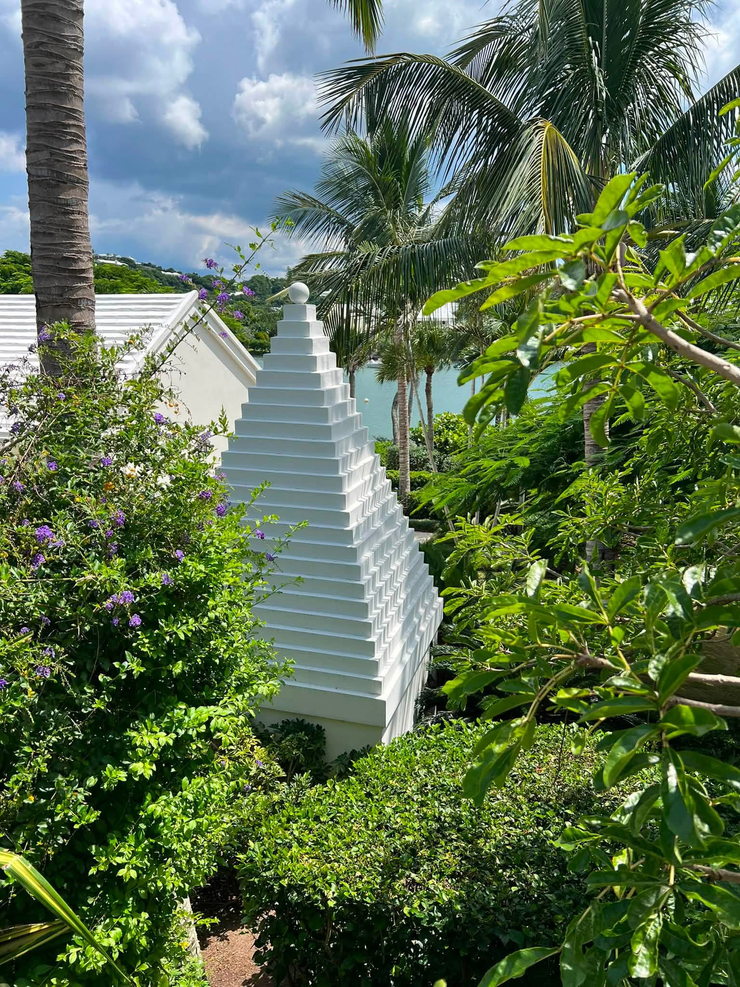
Sloping limestone roofs of Bermudian buildings - ideal to catch precious fresh (rain) water!
Bermuda Travel Tips: Your Essential Guide
When to Visit: Bermuda’s subtropical climate makes it a beautiful destination year-round, with mild winters and warm, balmy summers. Because of its unique North Atlantic location, the island has more pronounced seasonal shifts than the tropical Caribbean.
May to June (The Sweet Spot): Balmy 24–27°C (75–80°F) Comfortable humidity, with consistent sunshine, long days, and water perfectly warm for swimming
July to August (Peak Summer): Highs around 28–30°C (82–85°F), with high humidity (~80%+) and warm ocean water. Ideal for helmet diving, though hotel rates are at their highest.
September and October (Thinned-out extension of summer): Highs around 28–30°C (82–85°F). I went in September and enjoyed lovely weather, with occasional rain. Note: It is hurricane season, so you need to be flexible in your plans!
November to February (Low Season): Crisp 16–21°C (61–70°F). It is too chilly for sunbathing or swimming, but perfect for quiet sightseeing, uncrowded golf, and deep travel discounts.
March to April (Spring Shoulder): Refreshing 18–21°C (65–70°F) with cooler evenings. Ideal weather for golfing and walking the Railway Trail without breaking a sweat.
Transport: Note that Bermuda does not allow visitors to rent out "conventional" cars. The only cars that can be rented are the "toy" EVs, suitable for 2 people, with very little luggage room (and remember, you need to be comfortable driving on the left.) Here are other options:
Scooters / mopeds: Not recommended, due to the narrow and curvy roads.
The Public Bus & Ferry System (The Local Way)Bermuda’s public transit—famously known as the "Pink 'n Blue" buses—and the scenic Sea Express Ferries are highly efficient, safe, clean, and incredibly affordable.The bus system is divided into 11 routes and 14 zones, blanketing almost the entire 21-mile island. Pink poles at bus stops mean the bus is heading into the city of Hamilton, while blue poles mean it is heading out. Payment: Avoid paying cash on the bus (drivers require exact change in coins only; bills are not accepted). Instead, purchase a multi-day Transportation Pass (available on the Shorelink app or at Visitor Centres). A 1-day pass is $19, and a 7-day pass is just $45, offering unlimited rides on both buses and ferries.
Sightseeing by private taxi: You can hire a taxi driver for a private, customized tour of the island for a regulated rate of $60/hour (for up to 4 passengers) or $85/hour (for 5 to 7 passengers). While not strictly necessary, this is a fantastic, stress-free luxury option if you want a local to show you around for a morning.
Where to stay:
The entire place is dotted with hotels and resorts. Here are a few:
Hamilton Princess and Beach Club (luxury): This is where I stayed and would recommend for first-timers, since you have convenient access to where the action is: Hamilton. Famously known as the "Pink Palace," this iconic 1885 resort sits right on Hamilton Harbour. It features a world-class modern art collection (so huge that they have a dedicated QR code!), an infinity pool overlooking the harbor, and a private beach club at Sinky Bay reached via a free shuttle.
The Rosedon Hotel (boutique): A stunning, early 20th-century mansion turned boutique Relais & Châteaux property surrounded by lush tropical gardens, complete with a traditional open-air front porch.
St. Regis Bermuda Resort (luxury): Situated on 21 acres of tropical gardens, this resort is famous for housing the island's only all-inclusive package. The property is home to private pink-sand beaches and natural underground swimming caves


Comments